
The US specialty market, resolved provider by provider.
Voyager tells you who tests, who treats and who refers — segmented by biomarker-tested confirmed cohorts and enriched to the address and phone number your reps actually dial. It is built from laboratory testing and results data, aggregated and summarized to the individual healthcare provider.
153K
Specialty providers indexed
410K
Test results a month
18K
Laboratories tracked
3K
Pathology groups mapped
Four views, one resolved market
Voyager is built around the questions a commercial team actually asks: who are the providers, what are they testing, where do they sit in an organization, and how do we reach them.
-
01
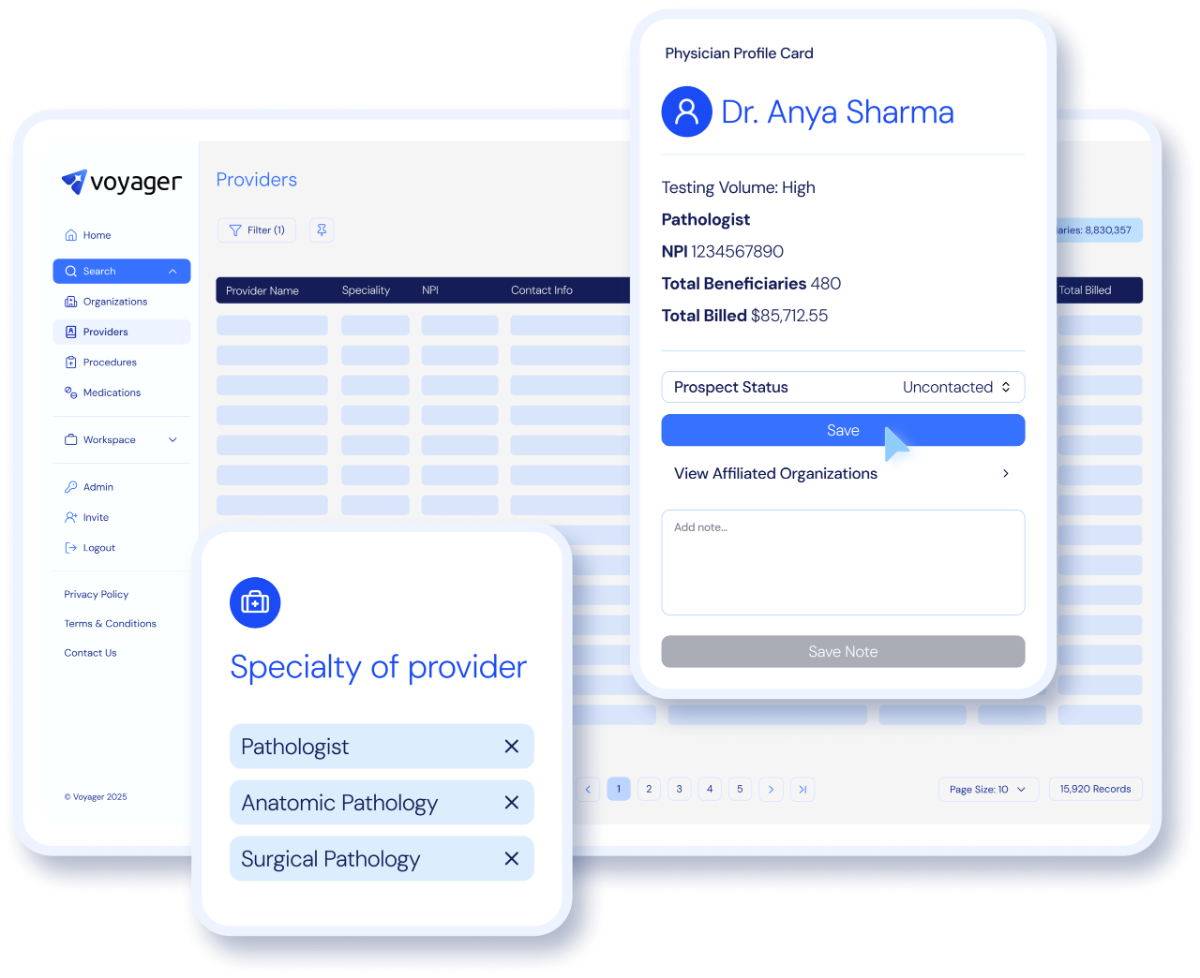
Provider search
Filter the market by specialty, biomarker, test type, organization and geography. Every result is a real provider resolved against the network, not a modeled estimate, so the list you build is the list your team can work.
-
02
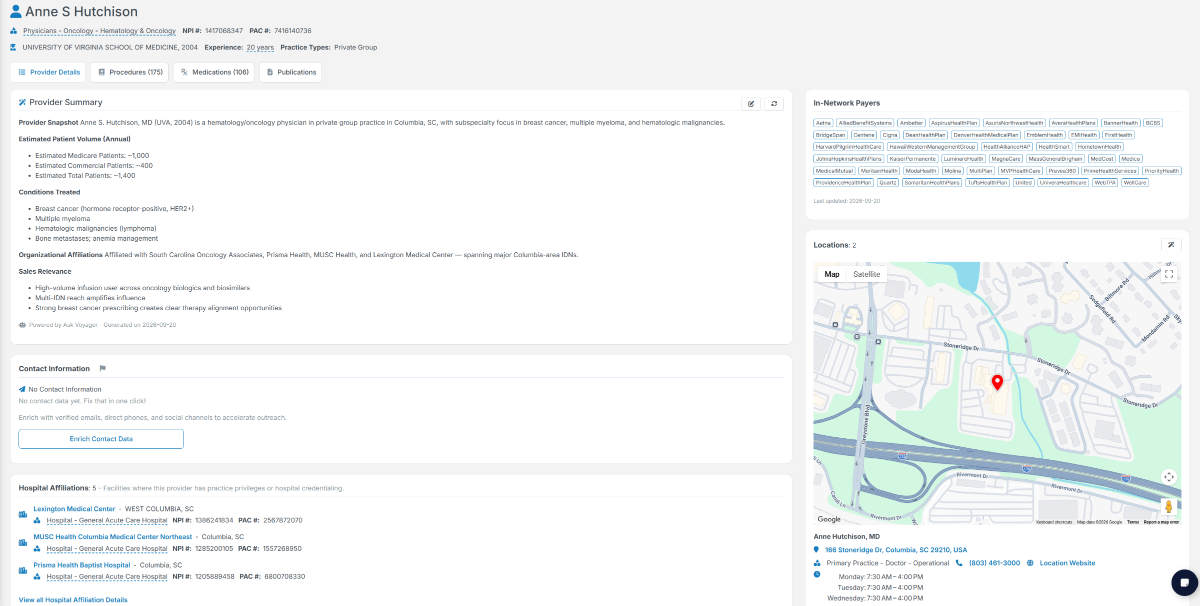
Provider profile
One record per provider: specialty, NPI and PAC, experience and practice type, a provider summary with estimated patient volume and conditions treated, in-network payers, hospital affiliations, and mapped locations with practice hours and contact detail.
-
03
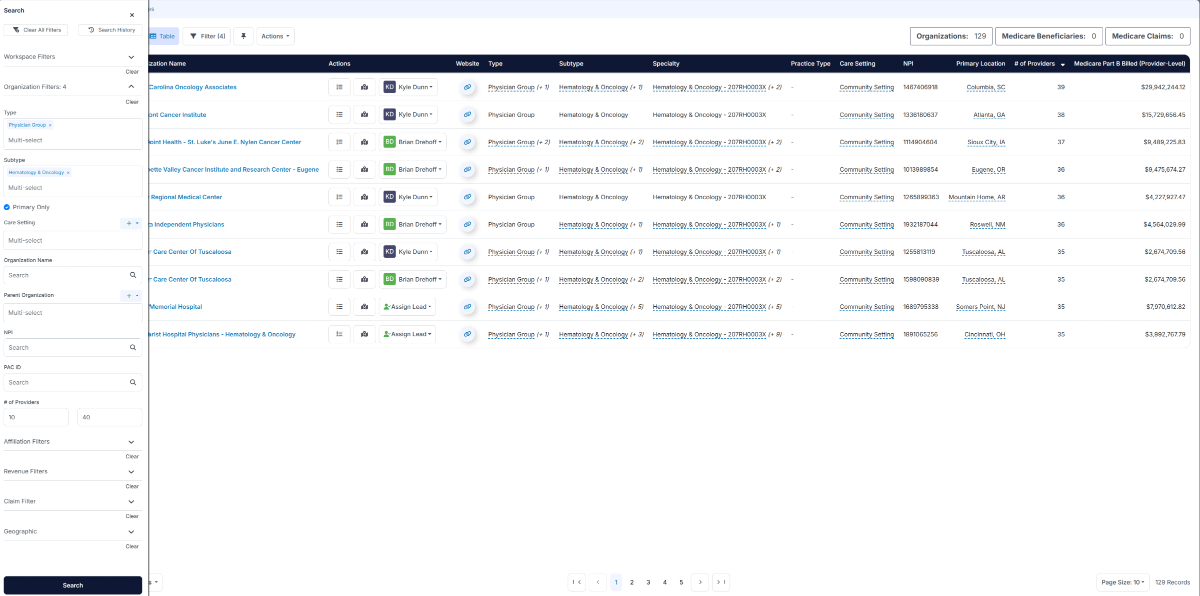
Physician groups and hospitals
Providers roll up to the organizations that actually make decisions. Filter by organization type, subtype and specialty, then see where testing volume concentrates inside a system, how many providers sit under each group, and what they bill.
-
04
Export and hand off
Take any view out as a working list. Exports carry the enriched fields and their provenance, so the target list that leaves Voyager is the same one your field team works from in the CRM.

The difference between a name and a visit
A provider record is only useful if a rep can act on it. Every provider in Voyager is enriched on four axes, and every field shows its source and refresh cadence.
-
01
In-network status
Whether the provider is in network, so territory planning starts from who is actually reachable under the plan rather than everyone with a matching specialty code.
-
02
Verified USPS postal address
Addresses validated against USPS rather than carried forward from a stale registry entry. Reps arrive at the location where the provider actually practices.
-
03
Practice hours and operations
When the site is open and how it operates, so a field visit is planned against reality instead of a guess.
-
04
Direct contact information
A way to reach the provider or the office, attached to the same record as the testing behavior that made them a target in the first place.
HCP Alerts
Brand and field teams can add biomarker and ICD-10 specific alerts to Voyager, flagging providers the same day their testing changes.
Lab Data Network coverage
Data sourced from the Hyperdrive Lab Data Network is a premium addition to Voyager. Partner laboratories send clinical, anatomic pathology and laboratory genomic data directly, and Nexus resolves it to organizations and providers — not a licensed panel every competitor can buy.
Laboratory testing and results data is aggregated and summarized to the individual healthcare provider before it reaches Voyager, so what you see is provider-level testing behavior. More about the Lab Network
Historical Medicare Part B and Part D
Voyager includes historical Medicare Part B and Part D claims data alongside network testing data, so provider behavior can be read against a longer record of procedures and prescribing.
The most recent Medicare data in Voyager is 2024. It is refreshed every two years, when CMS releases the next set.
Insight that reaches the CRM
A target list has no value sitting in a browser tab. Voyager exports the accounts, providers and enriched fields as structured files your operations team can load into the CRM, so the same resolved market shows up where reps already work.
Because each field carries its provenance and refresh cadence, records that land in the CRM can be reconciled against what you already have rather than overwriting it blind. Master data stays maintained against the network instead of rebuilt each quarter.
Common questions about Voyager
What level is the data reported at?
The individual healthcare provider. Laboratory testing and results data is de-identified, then aggregated and summarized to the provider before it reaches Voyager, so the platform reports provider-level testing behavior rather than anything below it.
Where does the data come from?
Partner laboratories in the Hyperdrive Lab Data Network send us clinical, anatomic pathology and laboratory genomic data directly. Nexus, our data platform, resolves it to organizations and providers and hands it to Voyager as insights and master data lists. Lab Data Network coverage is a premium feature. More about the Lab Network
How is privacy handled?
Participation in the network is built around HIPAA compliance and de-identification. Data is de-identified and aggregated to the provider before it is used in Voyager.
How current is the data?
Every field carries where it came from and how often it refreshes, so you can see what is current, what is aging and what was last verified rather than taking an insight on faith. Medicare Part B and Part D claims are the exception to a rolling cadence: the most recent set is 2024, refreshed every two years as CMS releases it.
Who is Voyager for?
Laboratory and diagnostics sales teams selling to specialty providers, pathologists and laboratories, and biopharma commercial teams building provider and account lists. Biopharma teams that need biomarker and ICD-10 alerts should see HCP Alerts.
See Voyager on your own market
Tell us the market, the specialties and the geography you care about. We will run it live against real accounts, real providers and real ordering behavior.
The target list we build on the call is yours to keep, whether or not you go further.